
When people hear the word Egypt, the first images that often come to mind are the Pyramids of Giza and the Great Sphinx. These monuments are undoubtedly among the world’s most famous archaeological sites. However, they represent only one chapter of a much larger and more fascinating story.
For travelers interested in ancient civilizations, Egypt for History Lovers offers far more than a visit to Giza.
Across the country, travelers can discover monumental temples, royal tombs, ancient cities, museums, religious complexes and archaeological sites that reveal how Egyptian civilization developed over thousands of years.
Among the most important destinations is Luxor. Located on the banks of the Nile, modern Luxor stands near the ancient city of Thebes and contains an extraordinary concentration of archaeological treasures. Karnak Temple, Luxor Temple, the Valley of the Kings and the Temple of Hatshepsut can turn a single excursion into a journey through several periods of ancient Egyptian history.
Travelers staying in Hurghada have an additional advantage. The Red Sea resort can serve as a comfortable base for combining beach relaxation with cultural excursions into Egypt’s ancient past.
Instead of choosing between a seaside holiday and a historical journey, visitors can enjoy both.
Why Egypt Is More Than the Pyramids
The Pyramids of Giza are among the best-known monuments in Egypt, but Egyptian history extends for thousands of years beyond the construction of the pyramids.
Different dynasties left their mark across the country.
Pharaohs built temples to gods and goddesses. Kings constructed elaborate tombs. Priests managed enormous religious centers. Artists covered walls with hieroglyphs and colorful scenes. Engineers created monumental structures that still attract visitors today.
This means that history lovers can explore many different aspects of ancient Egypt.
You can study royal architecture in Luxor, funerary traditions in the Valley of the Kings, religious beliefs at Karnak, royal propaganda at temples and daily life through museum collections and private tombs.
The result is a much more complete picture of ancient Egyptian civilization.
Luxor – The Essential Destination for History Lovers
If there is one destination that should be near the top of every historical traveler’s list, it is Luxor.
Modern Luxor occupies part of the area associated with ancient Thebes, one of the most important cities in ancient Egypt.
For long periods, Thebes was a political and religious center. Its importance became particularly strong during the New Kingdom, when powerful pharaohs expanded temples and constructed monumental royal projects.
Today, the Nile divides the region into two major areas.
The East Bank is associated primarily with temples and religious life.
The West Bank is famous for royal and private tombs, funerary monuments and the spectacular landscape of the Theban necropolis.
This division is not accidental.
Ancient Egyptian religious beliefs associated the western side of the Nile with the setting sun and the realm of the dead, while the eastern side was connected with the rising sun and life.
Understanding this symbolism makes a visit to Luxor much more meaningful.
Karnak Temple – A Monumental Religious Complex
Karnak Temple is one of the most impressive historical sites in Egypt.
It is important to understand that Karnak is not simply one temple built by one ruler.
It is a vast religious complex that developed over centuries.
Different pharaohs added structures, monuments, columns, obelisks and sanctuaries. As a result, Karnak provides a fascinating architectural record of ancient Egyptian religious and political history.
The complex was strongly associated with the worship of Amun, one of the most important deities of ancient Thebes.
The Great Hypostyle Hall
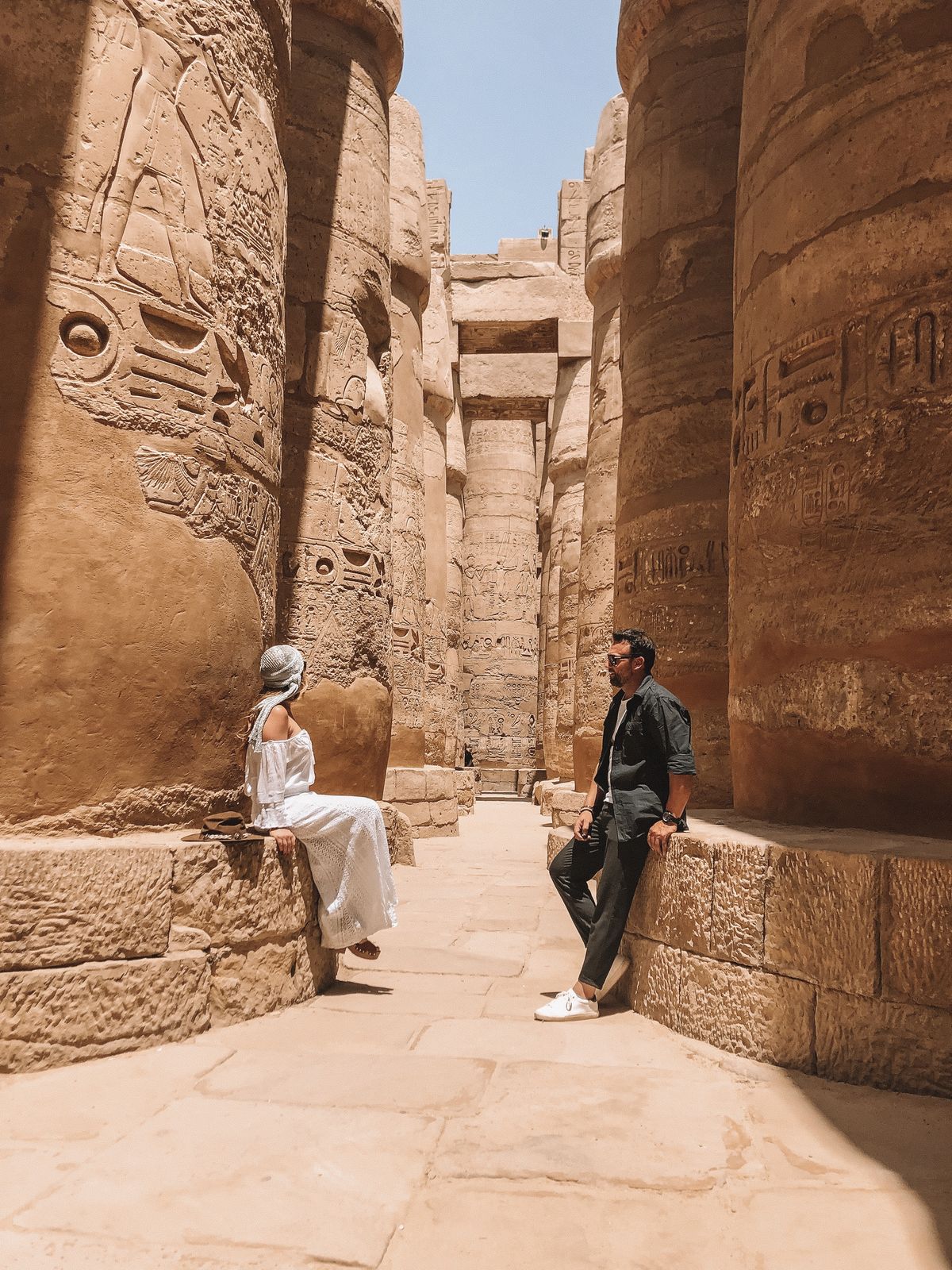
One of Karnak’s most spectacular features is the Great Hypostyle Hall.
Its enormous columns create a powerful sense of scale. Many surfaces are decorated with inscriptions and reliefs.
Look carefully at these decorations.
They can reveal how Egyptian kings represented themselves before the gods, how religious ceremonies were depicted and how royal authority was communicated through art.
For history lovers, this is one of the places where architecture and political symbolism become closely connected.
Obelisks and Royal Monuments
Karnak also contains important obelisks associated with Egyptian rulers, including Hatshepsut.
An obelisk was not simply decorative.
Its shape and inscriptions had religious and royal significance. Monumental structures such as these demonstrated the authority of the pharaoh while honoring the gods.
A guided visit can help explain the meaning behind the symbols rather than leaving visitors to see the complex only as a collection of ancient stones.
Luxor Temple – Religion, Kingship and Processions
Another major historical site on the East Bank is Luxor Temple.
Unlike Karnak, which developed into a huge religious complex over many centuries, Luxor Temple has its own distinctive history and architectural character.
The temple was connected with royal rituals and the worship of Amun and related deities.
One particularly important tradition was the Opet Festival.
During this festival, religious processions connected Karnak and Luxor Temple. The ceremony reinforced ideas of kingship, divine legitimacy and renewal.
This connection helps visitors understand that ancient Egyptian temples were not isolated buildings.
They were part of a larger religious landscape.
The Valley of the Kings – Inside the World of the Pharaohs
For many travelers, the Valley of the Kings is the highlight of a Luxor excursion.
Located on the West Bank, the valley served as a royal burial ground during the New Kingdom.
Instead of constructing enormous pyramids in open landscapes, rulers were buried in rock-cut tombs hidden within the surrounding hills.
The decision was connected partly to security and partly to religious ideas.
Inside the tombs, visitors can encounter corridors and chambers covered with religious texts, symbolic scenes, gods and representations connected with the journey to the afterlife.
The experience is completely different from standing outside a pyramid.
Here, the emphasis is on the private and religious world of royal burial.
Tutankhamun – The Tomb That Changed Archaeology
The most famous tomb in the Valley of the Kings belongs to Tutankhamun.
Tutankhamun was not one of ancient Egypt’s most powerful rulers, but the discovery of his largely intact burial chamber in 1922 transformed his reputation in the modern world.
The discovery provided extraordinary insight into royal burial practices and material culture.
However, history lovers should not make the mistake of thinking that Tutankhamun is the only reason to visit the Valley of the Kings.
Other tombs can offer remarkable decorations, long corridors and complex religious imagery.
The availability of individual tombs can change because of conservation and site-management decisions, so travelers should check current access information before visiting.
The Temple of Hatshepsut – The Story of a Remarkable Pharaoh
On the West Bank stands another extraordinary monument: the Temple of Hatshepsut at Deir el-Bahari.
Its architecture immediately distinguishes it from many other Egyptian temples.
Large terraces rise against the cliffs, creating a dramatic relationship between architecture and landscape.
But the historical story behind the temple is equally fascinating.
Hatshepsut became one of ancient Egypt’s most successful female rulers. She adopted the traditional royal imagery associated with the pharaoh and commissioned major building projects.
Her temple therefore tells a story about power, religion, trade and royal identity.
The Expedition to Punt
One of the most interesting themes represented at the temple is the famous expedition to Punt.
Reliefs show aspects of the expedition and the exotic goods associated with it.
For visitors interested in economic history, these scenes are particularly valuable because they provide information about long-distance trade and the products valued by the Egyptian court.
Ancient Thebes – Understanding the City Behind the Monuments
To truly appreciate Luxor, it helps to think beyond individual attractions.
Thebes was not simply a place where temples and tombs happened to stand.
It was a functioning city.
People lived, worked, worshipped and governed here.
Priests served in temples. Craftsmen created statues and decorated tombs. Administrators managed resources. Farmers worked the land around the Nile.
Royal monuments were therefore connected to a much larger social system.
This is why visiting private tombs can be so rewarding.
Unlike royal monuments, some private tombs contain scenes showing agriculture, food production, crafts, music, hunting and family life.
They provide glimpses into the daily world behind the monumental image of the pharaohs.
The Colossi of Memnon
Near the major monuments of the West Bank stand the Colossi of Memnon.
These enormous statues depict Amenhotep III.
They once formed part of a much larger funerary temple complex. Although much of the original temple has disappeared, the surviving statues remain impressive.
The name “Memnon” comes from a later Greek tradition rather than the original Egyptian identity of the monument.
This is an interesting example of how ancient sites were interpreted differently by later civilizations.
For travelers, the colossi provide another opportunity to understand the scale of royal building projects during the New Kingdom.
Museums – Egypt’s History Beyond Archaeological Sites
Not all historical experiences require walking through ancient ruins.
Egypt’s museums provide another essential way to understand the country’s past.
Museums allow visitors to see objects that cannot remain in their original archaeological locations.
These collections can include:
- statues;
- jewelry;
- funerary objects;
- papyri;
- royal artifacts;
- pottery;
- tools;
- religious objects;
- everyday items.
One of the most important museum experiences in Cairo is the Grand Egyptian Museum, which provides a modern setting for exploring ancient Egyptian heritage.
The Egyptian Museum in Cairo also remains historically significant and contains extensive collections representing different periods of Egyptian history.
For travelers, museums are particularly useful after visiting archaeological sites because they provide additional context.
The Egyptian Museum in Cairo
The Egyptian Museum in Cairo has long been one of the world’s best-known collections of ancient Egyptian antiquities.
Its importance goes beyond individual famous objects.
The collection helps demonstrate the enormous chronological and cultural diversity of Egyptian civilization.
Visitors can encounter objects from different dynasties and periods, allowing them to compare changes in artistic styles, religious practices and royal traditions.
A museum visit can therefore complement an excursion to Giza or Luxor.
The Grand Egyptian Museum
The Grand Egyptian Museum near Giza represents a modern approach to presenting Egypt’s ancient heritage.
Its location near the pyramids makes it possible to combine monumental archaeology with museum-based interpretation.
For history lovers, this creates an opportunity to place individual artifacts within a much broader narrative.
A visit can be especially useful for travelers who want more than photographs of the pyramids.
Abydos – An Important Destination for Serious History Lovers
Travelers with more time can consider destinations beyond the standard Luxor itinerary.
Abydos was one of ancient Egypt’s most important religious centers.
It was strongly associated with Osiris, the god connected with death, resurrection and the afterlife.
The Temple of Seti I is particularly famous for its reliefs and inscriptions.
Abydos demonstrates how ancient Egyptian religious geography extended far beyond the most famous tourist sites.
Because it requires additional travel planning, it is better suited to travelers with more time or those particularly interested in archaeology.
Dendera Temple – Another Historical Treasure
The Temple of Hathor at Dendera is another important destination for history lovers.
The temple is famous for its detailed reliefs and astronomical symbolism.
Hathor was associated with love, music, motherhood and joy, among other aspects of ancient Egyptian religious life.
The site offers a different perspective from the monumental royal temples of Luxor.
A visit to Dendera can be combined with other historical destinations depending on the available time and transportation arrangements.
Edfu and Kom Ombo
For travelers interested in temple architecture, the Nile Valley offers even more possibilities.
The Temple of Horus at Edfu is among the best-preserved ancient Egyptian temples.
Its inscriptions and reliefs provide valuable information about Egyptian mythology and temple rituals.
Kom Ombo is also distinctive because of its unusual dual dedication.
The temple was associated with Sobek, the crocodile god, and Horus.
These sites demonstrate that Egyptian history did not end with the famous monuments of the Old Kingdom or the New Kingdom.
Different periods continued to build, adapt and reinterpret Egyptian religious traditions.
How Travelers in Hurghada Can Add History to Their Holiday
Hurghada is best known as a Red Sea resort, but it can also serve as a starting point for historical exploration.
This is particularly useful for travelers who want to combine two completely different experiences.
One part of the holiday can focus on:
- beaches;
- swimming;
- snorkeling;
- diving;
- boat trips;
- island excursions.
The other part can focus on:
- temples;
- museums;
- ancient tombs;
- archaeological sites;
- Egyptian history.
This combination allows visitors to enjoy both relaxation and cultural discovery.
Hurghada to Luxor – One of the Best Historical Excursions
For travelers staying in Hurghada, Luxor is one of the most logical historical excursions.
A well-planned day trip can include several major highlights.
A typical program may include:
- Early departure from Hurghada.
- Arrival in Luxor.
- Visit to Karnak Temple.
- Crossing the Nile or traveling toward the West Bank.
- Valley of the Kings.
- Temple of Hatshepsut.
- Colossi of Memnon.
- Lunch or a scheduled break.
- Return journey to Hurghada.
The exact itinerary depends on the tour provider and travel arrangements.
Because the journey is long, comfortable transportation and good organization are particularly important.
Travelers interested in exploring historical Egypt from Hurghada can consider local excursion providers such as Best Tours Hurghada, especially when looking for organized trips that combine transportation, sightseeing and guided experiences.
A One-Week History-Focused Holiday from Hurghada
You do not need to spend the entire vacation visiting archaeological sites.
A balanced itinerary could look like this:
Day 1 – Arrival and relaxation
Spend the first day recovering from travel.
Enjoy the hotel, beach or pool.
Day 2 – Red Sea experience
Take a snorkeling or island excursion.
This creates a relaxed contrast before the cultural days.
Day 3 – Free day
Use the day for rest.
Day 4 – Luxor
Visit Karnak, the Valley of the Kings, Hatshepsut Temple and the Colossi of Memnon.
Day 5 – Relaxation
Return to the Red Sea.
Day 6 – Cairo
If you want to see Giza and major museums, plan a long cultural excursion.
Day 7 – Final beach day
End the holiday with a relaxed day beside the sea.
This schedule avoids placing several exhausting excursions next to each other.
A Ten-Day Itinerary for History Lovers
If you have ten days, the schedule can be more relaxed.
Day 1: Arrival
Day 2: Hurghada and Red Sea
Day 3: Snorkeling and island trip
Day 4: Rest
Day 5: Luxor
Day 6: Rest
Day 7: Cairo and Giza
Day 8: Rest
Day 9: Additional historical excursion or museum visit
Day 10: Beach and departure
The additional day can be used for another cultural site, a museum, or simply more time to enjoy Hurghada.
How to Combine History With a Beach Holiday
The key is not to treat every day as a sightseeing day.
Historical excursions can be physically demanding.
Temples often require walking outdoors. Archaeological sites can involve stairs, uneven surfaces and exposure to the sun.
After a long historical excursion, a relaxed beach day can feel particularly rewarding.
A good rhythm is:
Culture → Rest → Sea → Rest → Culture.
This allows you to experience more without turning the holiday into a race.
Why a Guide Can Make Historical Sites More Interesting
Ancient Egyptian monuments contain enormous amounts of information.
Hieroglyphs, reliefs and architectural details can be difficult to understand without context.
A professional guide can explain:
- who built the monument;
- which god was worshipped there;
- what the symbols mean;
- why the site was constructed;
- how the monument changed over time;
- what happened to the site later;
- how archaeologists discovered or studied it.
This can transform a visit.
Instead of simply seeing a wall covered in figures, you understand the story behind the images.
Practical Tips for History Lovers Visiting Egypt
Start early
Early morning is often more comfortable for outdoor archaeological sites.
Wear comfortable shoes
Historical sightseeing involves plenty of walking.
Carry water
Hydration is essential, especially during visits to exposed archaeological sites.
Protect yourself from the sun
Use sunscreen, sunglasses and a hat.
Wear appropriate clothing
Light, comfortable clothing works well, but more conservative clothing can be useful when visiting religious or culturally significant places.
Carry a small backpack
A small day bag can hold water, sunscreen, identification documents and other essentials.
Do not touch ancient monuments
Preserving archaeological sites is everyone’s responsibility.
Respect photography rules
Some tombs and museums may have specific photography restrictions.
Why Historical Context Makes Egypt More Fascinating
Imagine standing inside a tomb covered with scenes from the Book of the Dead.
Without context, the images may look mysterious.
With a basic understanding of Egyptian beliefs, they become part of a story about death, judgment, transformation and eternal life.
The same principle applies to temples.
A relief showing a pharaoh standing before a god is not merely decoration. It reflects ideas about divine authority, kingship and the relationship between the human and spiritual worlds.
This is why history lovers should spend some time preparing before a trip.
You do not need to become an Egyptologist.
Even a basic understanding of major gods, dynasties and historical periods can transform the travel experience.
The Best Historical Experiences Beyond Giza
If you have limited time, prioritize according to your interests.
For royal history
Visit the Valley of the Kings and Hatshepsut Temple.
For religious architecture
Visit Karnak and Luxor Temple.
For museums
Explore Cairo’s major museum collections.
For later temple architecture
Consider Edfu, Kom Ombo or Dendera.
For religious history
Explore Abydos and sites associated with Osiris.
For understanding daily life
Visit private tombs and museum collections.
This approach makes it easier to build a personalized historical itinerary.
Egypt for History Lovers – The Experience Is Bigger Than the Monuments
The greatest attraction in Egypt is not one individual monument.
It is the connection between thousands of years of history.
A temple tells you about religion.
A tomb tells you about beliefs surrounding death.
A statue tells you about royal power.
A museum object tells you about craftsmanship and everyday life.
A city such as ancient Thebes connects all of these elements together.
Once you understand those connections, Egypt becomes much more than a collection of famous tourist attractions.
It becomes a historical landscape.
FAQ – Egypt for History Lovers
What is the best historical destination in Egypt besides Giza?
Luxor is one of the best choices. Its combination of Karnak, Luxor Temple, the Valley of the Kings and Hatshepsut Temple makes it exceptionally rich in historical attractions.
Can I visit Luxor from Hurghada?
Yes. Luxor is a popular excursion destination for travelers staying in Hurghada. Because the journey takes several hours, organized transportation can make the trip easier.
Is Karnak Temple worth visiting?
Absolutely. Karnak is one of Egypt’s most important ancient religious complexes and offers an extraordinary combination of architecture, inscriptions and historical context.
What can I see in the Valley of the Kings?
The valley contains numerous royal tombs decorated with religious texts, scenes and symbols. The exact tombs open to visitors can vary.
Why is Hatshepsut Temple important?
The temple is significant both architecturally and historically. It is connected with Hatshepsut, one of ancient Egypt’s most notable female rulers.
Is Luxor better than Cairo for history lovers?
Both destinations offer different experiences. Cairo is essential for Giza and major museum collections, while Luxor provides an exceptional concentration of temples, tombs and New Kingdom monuments.
How many days do I need for a history-focused Egypt trip?
A week can provide a good introduction. Ten to fourteen days allow for a more relaxed itinerary combining Cairo, Luxor, museums and additional archaeological destinations.
Can I combine a beach holiday with historical sightseeing?
Yes. Hurghada is particularly suitable for this combination because travelers can alternate Red Sea activities with excursions to historical destinations.
Should I book a guided historical tour?
A guide is not always essential, but it can greatly improve your understanding of temples, tombs and hieroglyphs.
What should I wear when visiting ancient sites?
Light, comfortable clothing and sturdy shoes are recommended. A hat and sun protection are also useful. When visiting religious or culturally sensitive places, more conservative clothing is appropriate.
Final Thoughts – Discover the Egypt That Exists Beyond the Pyramids
The Pyramids of Giza may be the image most strongly associated with Egypt, but they are only the beginning.
For Egypt for History Lovers, the real adventure continues along the Nile.
Luxor reveals the monumental world of ancient Thebes.
Karnak demonstrates the scale and complexity of Egyptian religious architecture.
The Valley of the Kings opens a window into royal burial traditions.
Hatshepsut Temple tells the story of an extraordinary ruler.
Museums preserve artifacts that help connect individual monuments with everyday life, religion and royal culture.
Abydos, Dendera, Edfu and Kom Ombo demonstrate that Egypt’s historical landscape extends far beyond the most famous tourist attractions.
For travelers staying in Hurghada, the combination is especially appealing. You can spend one day snorkeling among the coral reefs of the Red Sea and the next walking through temples that are thousands of years old.
That contrast is one of the great advantages of an Egyptian holiday.
If you want to explore the historical side of Egypt while staying in Hurghada, consider planning an organized excursion with Best Tours Hurghada. A well-organized tour can help you make the most of limited holiday time while providing transportation and access to some of the country’s most important historical destinations.
CTA
Ready to discover the Egypt beyond the Pyramids of Giza?
Plan your next cultural adventure from Hurghada and explore Luxor, Karnak Temple, the Valley of the Kings, Hatshepsut Temple and the fascinating heritage of ancient Thebes.
Combine the history of the pharaohs with the beauty of the Red Sea and turn your Egyptian holiday into a journey through thousands of years of civilization.
Book your historical excursion with Best Tours Hurghada and discover the stories, temples and ancient cities that make Egypt one of the world’s greatest destinations for history lovers.